
 Posted by
You're an R&D engineer working on a neurovascular delivery catheter.
In front of you is a piece of PTFE thin-wall tubing with an outer diameter of 2.4Fr and a nominal wall thickness of 0.08mm — thinner than a sheet of standard A4 printer paper. Every aspect of your distal access catheter's design, simulation, and prototype validation is built around that single number. Your regulatory dossier has locked in that specification.
Your upstream supplier delivers a batch. You pull ten samples, measure them meticulously with a calibrated micrometer, and find a systematic deviation — every single tube is, on average, 0.015mm too thick. Against a nominal 0.08mm wall, that's a nearly 20% variance.
You take the data to the supplier. Their response: "This is within our instrument's margin of error. It's close enough to use."
This is not error. Error is random, normally distributed. This is systematic deviation — meaning they simply don't possess the process capability to control this parameter.
Now, your catheter is failing simulated guide-catheter compatibility tests because that 0.015mm overage pushes the OD out of spec. The tubing you received isn't covered by your regulatory filing. What's your move? Redesign? Switch suppliers? Or delay the project and wait for a miracle from a vendor who operates on "close enough"?
For a supplier that has been manufacturing medical-grade PTFE thin-wall tubing in Changzhou for 19 years, the scenario above isn't a theoretical exercise. It's an actual customer complaint — lived, diagnosed, and resolved. Fobos Polymer's thin-wall tubing series is supported by full-process batch records — from raw material lots, extrusion parameters, and cooling curves to slitting and packaging. Traceability documentation is issued in accordance with ISO 13485 requirements. Standard stock ships within 72 hours.
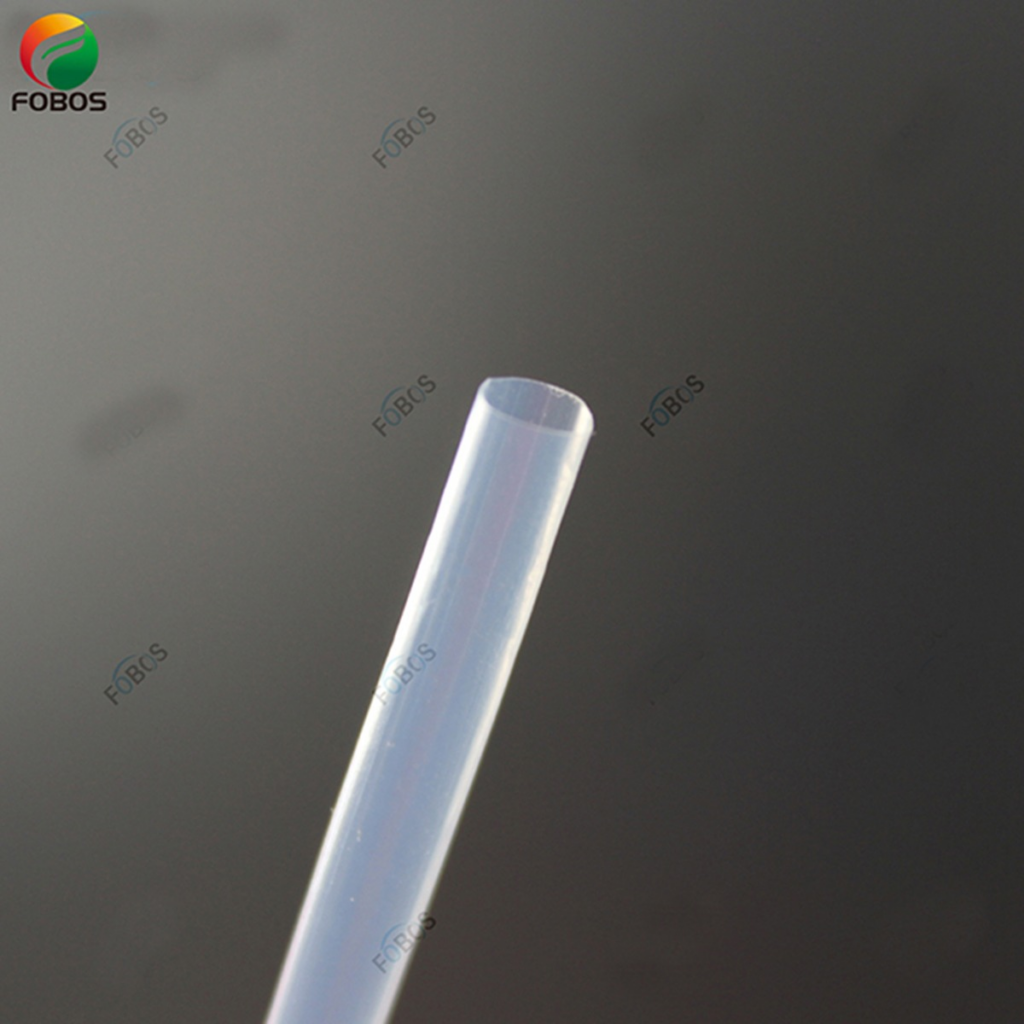
PTFE thin-wall medical tubing, outer diameter from 1.8Fr to 10Fr. Fobos Polymer supports Ra ≤0.2μm inner surface roughness control and ±0.03mm OD tolerance for medical device applications.
1. "Just Right" Wall Tolerance Is the Number One Killer of Process Lock-In
Many engineers define thin-wall tubing by telling the supplier, "Just follow industry standard tolerances."
That sentence is often the prelude to a disaster.
For a tube with a 0.1mm wall, a tolerance band of ±0.015mm means process variation must be contained within an extraordinarily narrow window. Standard extrusion line control simply cannot achieve this. What you get instead are two flavors of compromise: the wall is either too thin — helping trackability but failing burst pressure testing in tortuous anatomy — or too thick, exceeding OD specifications and failing assembly validation with the mating guide catheter.
The supplier's shipment might measure "close enough" at a single point. But the inter- and intra-lot variability is so extreme it makes your process impossible to freeze. You attempt design lock-in, only to discover there are no stable parameters to lock. Minor lot-to-lot raw material shifts, day-to-night ambient temperature swings — all of it pushes their uncontrolled process window adrift.
Your process is built on quicksand.
2. Inner Surface Roughness: The Parameter Nobody Discusses, Yet Everyone Trips Over
This is a critical parameter almost universally omitted from procurement specifications: inner surface roughness (Ra).
The lumen of thin-wall tubing is the sole pathway for guidewires and embolic coils. Any hint of "stickiness" a physician perceives through torque feedback in the OR is not some ineffable mystery — it correlates directly to the lumen's microscopic topography. A 0.2μm difference in Ra seems trivial? Over a meter-long, highly confined lumen, that difference is dramatically amplified.
When your clinical feedback form comes back noting "high push resistance," your first instinct is to scrutinize the coating, the guidewire, or the tip design. Rarely does anyone slice open the tube and measure the inner surface with white-light interferometry.
Here's the question: does your supplier provide Ra values on their lot release certificate? Or are they fundamentally unaware that "lumen quality control" is a thing in medical-grade tubing? A supplier who can't quantify inner surface quality is outsourcing their QC to the end-user — your clinical trial physician.
Fobos Polymer's medical-grade thin-wall tubing series spans 1.8Fr–10Fr, with an outer diameter tolerance of ±0.03mm (vs. a typical industry standard of ±0.08mm), wall thickness from 0.05–0.3mm, and supports inner surface roughness control down to Ra ≤0.2μm. We provide batch wall thickness distribution charts, burst pressure test data, post-sterilization performance degradation data, and lot-specific inspection reports shipped with every order.
3. Lot-to-Lot Consistency: The Dividing Line Between Medical-Grade and Industrial-Grade
You receive a batch of 1.8Fr thin-wall tubing with a measured ID of 0.68mm. Performance is flawless. Three months later, the next lot of the same specification arrives. You begin a small pilot build, and the guidewire compatibility test failure rate skyrockets.
You measure: the ID is now 0.72mm.
The supplier shrugs: "A 0.04mm variation is normal. It's within tolerance."
This 0.04mm represents a nearly 6% shift in inner diameter. For a macro-industrial component, that might be high precision. For a lumen designed for a 0.014-inch guidewire, it's a chasm.
Your clinical trial enrollment is waiting. Your regulatory change window is unforgiving. You cannot afford the supplier's definition of "normal variation."
This inter-lot drift stems from a lack of systematic process control. They may use the same parameter settings, but a change in raw material lot, natural die wear, or seasonal shifts in cooling water temperature were never identified as critical variables requiring monitoring and compensation. Lot-to-lot consistency isn't sorted out at final inspection; it's engineered into the process. This is the fundamental gap between a medical-grade and an industrial-grade supplier.
4. Post-Sterilization Performance Decay: The Data You Need, That Suppliers Avoid Discussing
Thin-wall tubing is exponentially more sensitive to sterilization than standard-walled stock. Gamma irradiation at 25-50 kGy, or autoclaving at 134°C, induces chain scission in PTFE at the molecular level — tensile strength and elongation at break both decline. The thinner the wall, the more acute the effect. An excessive drop renders the tube brittle and prone to fracture in vivo.
When you prepare your Biological Evaluation Report, a core concern of regulatory bodies is this: does the final, sterilized device still meet its intended performance specifications?
If your supplier cannot provide precise post-sterilization performance degradation data — say, elongation dropping from 300% to 250% after a full cycle — you are left to expend your own time and samples to fill this gap, or worse, submit your dossier with an unknown risk.
Here's what makes this absurd: this is a risk verification blind spot that should never be the sole burden of the device manufacturer.
5. The Hidden Cost of Switching Suppliers: You Thought It Was Cheaper — It's Exponentially More Expensive
You've used Supplier A's tubing for three years. You've characterized their quirks. Your entire catheter lamination process, coating parameters, and assembly fixtures have been tuned to their specific — perhaps not perfect, but stable — output.
Now, to shave 10% off the BOM cost, you introduce lower-cost Supplier B. Same nominal OD. The ID is off by 0.05mm. The wall concentricity profile is completely different.
Line trial begins. The finished catheters fail your in-house release testing.
You start troubleshooting, tweaking parameters, burning through engineering hours and raw materials. Eventually, you reach a grim conclusion: to accommodate Supplier B's tubing, your entire distal tip-forming process needs to be essentially redeveloped. This triggers new process validations, potentially new accelerated aging studies, and the most terrifying question of all — is this a significant design change requiring new ISO 10993 biocompatibility testing and a regulatory resubmission?
Six months minimum. Over a million dollars in real costs.
The hundred thousand you saved on tubing doesn't even cover the down payment. In medical-grade thin-wall tubing, the switching cost is an order of magnitude higher than the unit price difference.
6. The Low-Volume, Multi-SKU Dilemma: Who Can Keep Up with Your Innovation Velocity?
You're working on an innovative concept. You need 200 pieces of 2.4Fr, 0.08mm wall, ±0.03mm tolerance, 1200mm long PTFE tubing for a design verification build.
You reach out to three suppliers.
One tells you that you're below their minimum order quantity. Another says they can do it, but the lead time is 8 weeks, and the quote includes a painful tooling surcharge. A third offers a vague price, but you know that when the order is placed, your 200 units will be queued behind every high-volume job, and actual delivery will remain a mirage.
Medical device iteration cycles are accelerating. The need for low-volume, multi-SKU, high-precision, rapid-turnaround thin-wall tubing in early-stage projects has become acute. But the business models of most extruders are built on high-volume industrial commoditization. They have neither the will nor the flexible line capacity to service R&D-scale demand.
A supplier who can't match your development cadence isn't a partner. They're an anchor.
7. The Thin-Wall Misconception: It's Not Just "Thinner" — It's Exponentially Harder
There's a pervasive fallacy in the industry: that thin-wall tubing is simply a scaled-down version of conventional stock. Just make the wall a little thinner.
This is a fundamental misunderstanding of polymer physics.
Moving from a 0.2mm wall to a 0.08mm wall doesn't make the challenge 2.5 times harder — it makes it an order of magnitude more difficult. First, the precision requirement is exponentially amplified. A 0.1 RPM screw speed drift, a 1°C melt temperature fluctuation — any micro-perturbation registers as a massive percentage deviation in wall thickness under thin-wall conditions. Second, the cooling uniformity challenge multiplies. The thin melt exiting the die loses heat with extreme rapidity and non-uniformity. A slight draft, a gradient in ambient shop-floor temperature, can cause uneven crystallization, severe internal stress, and the tube either loses flexibility or simply ovalizes. Third, the barrier to inner surface quality control rises steeply. At these micro-scales, any sub-micron imperfection on the mandrel or die tip is faithfully replicated onto the lumen surface, creating microscopic obstacles to guidewire passage.
The barrier to entry in medical-grade thin-wall tubing isn't the cost of the extruder. It's whether the supplier systematically controls every process variable that influences wall uniformity and lumen quality — from resin drying, melt filtration, temperature profiling, and vacuum sizing to puller speed and cooling medium temperature.
About Fobos Polymer
Fobos Polymer is based in Changzhou, Jiangsu, China, and has been focused on the R&D and manufacturing of high-performance PTFE finished tubing and profiles since 2006. We are ISO 9001:2015 certified, and our medical-grade thin-wall tubing series is manufactured in compliance with ISO 13485 requirements. Materials can pass USP Class VI and ISO 10993 biological evaluation, and we support IQ/OQ/PQ documentation packages. Our Changzhou facility employs full-process inspection records, from raw material to finished product, ensuring complete batch traceability. Our extrusion lines are dedicated to medical-grade production only — no cross-contamination with industrial-grade material. Backed by standard stock, we commit to shipping standard orders within 72 hours. Our products are supplied to medical device manufacturers across more than 50 countries and regions globally.
PTFE Medical-Grade Thin-Wall Tubing: Detailed Specifications
Fobos Polymer: Our Manufacturing Capabilities & Quality System
Technical Application & Selection Guide for Medical-Grade Polymer Materials