
 Posted by
 Standard dense PTFE tubing is manufactured by ram extrusion or paste extrusion, producing a fully dense, non-porous fluoropolymer wall with a molecular structure that is essentially impermeable to gases and liquids at standard temperatures and pressures. ePTFE—expanded polytetrafluoroethylene—takes an entirely different approach to fluoropolymer processing, using controlled mechanical expansion of skived PTFE tape into a microporous node-and-fibril microstructure that creates a three-dimensional network of interconnected air pockets within the fluoropolymer matrix. The result is a material that retains PTFE's celebrated chemical inertness and temperature resistance while simultaneously enabling selective permeability, moisture vapor transmission, and particulate filtration at levels that dense PTFE simply cannot achieve.
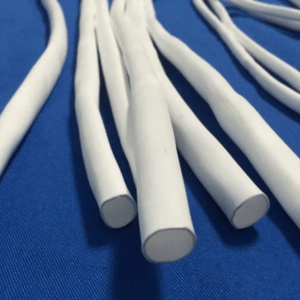
Fobos Polymer manufactures precision ePTFE microporous tubing for medical device, biopharmaceutical, and industrial filtration applications. Our ePTFE tubing combines the bio-inert, blood-compatible surface properties of medical-grade PTFE with a consistently controlled pore structure that can be specified from 0.1 to 15 microns in pore rating. The result is a tube that can serve as a venting membrane in implanted device packages, a moisture-barrier jacket for electronic assemblies, a filtration element in laboratory and process chromatography systems, or a protective sheath that shields sensors and electrodes while allowing gas or vapor exchange with the surrounding environment.
Medical device engineers select ePTFE microporous tubing for applications where conventional dense tubing would fail. A neurosurgical intracranial pressure sensor needs to communicate cerebrospinal fluid pressure readings to its electronics package while keeping biofluids out of the sensor element—a task that dense tubing cannot perform without adding a separate venting port that becomes a potential infection pathway. An implantable drug delivery reservoir needs to equalize pressure during filling and emptying cycles without allowing bacteria or particulate ingress. An oxygenator membrane in an ECMO circuit needs to transmit oxygen and CO₂ across a large surface area while keeping blood cells contained within the circuit. ePTFE microporous tubing addresses all of these challenges within a single tube wall.
What Makes ePTFE Different from Standard PTFE Tubing
Standard PTFE tubing—whether extruded as a dense tube or skived from a cylindrical billet—is solid fluoropolymer throughout its cross-section. The molecular chains that make up the PTFE material are packed densely enough that there are no connected void spaces between them. This gives dense PTFE its characteristic near-zero permeability, which is exactly what makes it the material of choice for chemical transfer lines, high-purity fluid delivery systems, and blood-contacting catheters. But there are situations where controlled permeability is a feature, not a limitation—and for those situations, ePTFE is the engineered solution.
The ePTFE manufacturing process begins with fine PTFE paste formed around a removable mandrel, then pre-formed and heated below the crystalline melt point in a process called sintering. The key manufacturing step is the expansion: the heated PTFE billet is pulled at controlled speed in the axial direction while maintained at precise temperature below the sintering point. This stretching action separates the PTFE chains and creates microporous nodes connected by fine fibrils—the characteristic node-and-fibril microstructure visible under electron microscopy that gives ePTFE its unique combination of strength, porosity, and chemical resistance.
The pore structure of ePTFE is not random. By controlling the expansion rate, temperature, and reduction ratio during manufacturing, producers can create materials with tightly specified pore size distributions—typically rated at a nominal pore size from 0.1 to 15 microns. At the smaller end of this range, ePTFE can function as a sterility venting membrane that prevents bacteria and spores from crossing the tube wall while allowing air to pass freely, maintaining pressure equalization in sealed packages. At larger pore ratings, ePTFE functions as a depth filter for laboratory and industrial fluid clarification. This pore size tunability is what makes ePTFE adaptable across such a wide range of applications.
Technical Specifications: Fobos Polymer ePTFE Microporous Tubing
Fobos Polymer ePTFE microporous tubing is available in standard and custom configurations to meet specific application requirements. Standard production specifications include:
- Pore size range: 0.1 µm to 15 µm nominal pore rating, with custom specifications available for specialized filtration requirements
- Tube outer diameter: 0.5 mm to 50 mm standard; custom sizes available for unique application geometries
- Wall thickness: 0.15 mm to 3.0 mm depending on diameter and pore rating requirements
- Porosity: 40% to 85% open porosity by volume depending on expansion ratio and pore rating
- Temperature resistance: -200°C to +260°C continuous service; short-term excursion to +300°C without degradation
- Chemical resistance: essentially inert across the full pH range; resistant to all common organic solvents, acids, and bases
- Water entry pressure (WEP): > 0.3 bar to > 3.0 bar depending on pore rating (higher pore ratings have lower WEP)
- Air flow: 0.5 to 25 L/min/cm² at 70 mbar pressure differential depending on pore size and membrane thickness
- Tensile strength: 10 to 45 MPa depending on expansion direction and porosity level
- Construction types: single-layer ePTFE tube, supported ePTFE tube with braided or extruded outer reinforcement, multi-layer composite constructions with non-porous inner liner
All Fobos ePTFE tubing is manufactured under ISO Class 7 cleanroom conditions for medical and biopharma applications. Batch-specific Certificates of Conformance are issued with each production lot, and extractables testing data using validated analytical methods is available for regulatory submission packages.
Medical Device Applications for ePTFE Microporous Tubing
Implantable drug delivery systems represent one of the most critical applications for ePTFE microporous tubing in medical devices. Programmable and passive implantable infusion pumps must maintain a sealed drug reservoir that can be accessed percutaneously for refilling while preventing infection at the access site. ePTFE tubing serves as a pressure-equalization and venting element within the pump's sealing mechanism—allowing air to escape during filling operations while creating a barrier that prevents bacterial ingress into the sealed reservoir. The chemical inertia of PTFE ensures that the tubing does not interact with any drug formulation, from small-molecule chemotherapy agents to large-molecule biologics, over the device's multi-year implantation lifetime.
In neurological sensing and recording devices, ePTFE microporous tubing enables sensor housings that must communicate with the cerebrospinal fluid environment while keeping the electronic sensing elements isolated from direct fluid contact. An intracranial pressure monitor built around an ePTFE microporous sensor sheath can maintain accurate pressure readings through the tube wall while keeping the electronics package isolated from CSF immersion. The result is a sensor that can remain functional over extended implantation periods without the fluid ingress failures that plague systems based on dense tube housings.
Oxygenator and artificial lung membrane systems represent another high-value medical application. ePTFE's microporous structure enables the high gas transfer rates needed for blood oxygenation while the node-and-fibril microstructure provides the mechanical strength required to withstand the pressure differentials and blood flow dynamics of an extracorporeal circuit. The material's inherent thromboresistance reduces the anticoagulation requirements compared to membrane materials that activate platelets, improving patient safety during extended ECMO support sessions.
In tissue engineering and regenerative medicine scaffolds, ePTFE tubing with controlled porosity supports cell infiltration and nutrient diffusion through the tube wall while providing mechanical structure. The interconnected pore network allows vascular ingrowth into the scaffold and enables the controlled release of growth factors and signaling molecules. Researchers working on tracheal regeneration, vascular grafting, and nerve guidance channels have adopted ePTFE as a scaffold material because its porosity and mechanical properties can be independently tuned to match specific tissue engineering requirements.
Industrial and Biopharmaceutical Filtration Applications
Beyond medical devices, ePTFE microporous tubing serves critical filtration and venting roles in biopharmaceutical manufacturing and industrial process systems. In laboratory scale-down filtration systems used during process development and validation, ePTFE tubing functions as a membrane filter element with the broad chemical compatibility needed to handle aggressive cleaning agents, sanitization solutions, and aggressive organic solvents used in pharmaceutical manufacturing. The ability to specify exact pore ratings from 0.1 µm to 15 µm means that filtration conditions can be precisely controlled during process characterization runs.
In industrial sensor protection applications, ePTFE microporous tubing shields sensors and transmitters from liquid splashes, dust, and particulate contamination while allowing atmospheric gases to reach the sensing element for accurate readings. Electronic pressure transmitters used in outdoor or wash-down environments benefit from ePTFE membrane venting that equalizes atmospheric pressure across the sensor diaphragm while preventing moisture and dust from compromising the measurement. The material's UV stability and outdoor weathering resistance ensure long-term performance without the degradation that plagues polymeric membrane alternatives.
In high-performance cable and wire assemblies, ePTFE microporous tubing serves as a protective jacket that provides moisture barrier properties while allowing any moisture that does penetrate the assembly to escape as vapor rather than accumulating as liquid water within the cable core. Aerospace and marine electrical systems particularly benefit from ePTFE cable jackets, where moisture ingress is a persistent threat to system reliability and where the weight savings from fluoropolymer jackets compared to rubber alternatives are operationally significant.
Quality System and Regulatory Support for Medical Device Manufacturers
Medical device manufacturers incorporating ePTFE tubing into Class II and Class III devices require extensive regulatory documentation. Fobos Polymer supports these requirements with a comprehensive quality and regulatory infrastructure:
- ISO 13485:2016 certified quality management system covering design, manufacturing, and distribution of medical-grade ePTFE tubing
- Batch-specific Certificate of Conformance with each production lot including pore size verification, bubble point test results, and dimensional inspection data
- Extractables testing documentation packages using validated LC-MS and GC-MS analytical methods, organized per ISO 10993-18 requirements
- Biocompatibility testing support with documentation packages organized per ISO 10993 for blood-contacting and tissue-contacting applications
- Process validation documentation packages including Installation Qualification (IQ), Operational Qualification (OQ), and Performance Qualification (PQ) protocols for custom configurations
- Confidentiality agreements available for proprietary device development programs under NDA protection
- Material change notification procedure ensuring device manufacturers receive 90-day advance notification of any raw material or process changes that could affect device performance
Frequently Asked Questions About ePTFE Microporous Tubing
What pore size should I specify for my implantable drug delivery application? For implantable drug delivery pressure-equalization applications, a pore rating of 0.1 to 0.5 µm provides optimal performance—small enough to prevent bacterial ingress (most common pathogens are 0.5 µm or larger) while allowing unrestricted air flow for pressure equalization during refilling. For filtration applications where you need to retain particles of a specific size, specify the pore rating at the particle size you need to retain plus a safety factor of 2-3x.
Can ePTFE tubing be sterilized using autoclave, gamma radiation, or ethylene oxide? Yes. ePTFE is compatible with all standard medical device sterilization methods. Autoclave sterilization (121°C steam, 30-minute cycle) does not affect the pore structure or mechanical properties. Gamma radiation up to 50 kGy is well tolerated with minimal property changes. Ethylene oxide (EtO) gas sterilization is fully compatible and is the preferred method for many implantable device applications since it does not require elevated temperatures that could affect the ePTFE microstructure.
What is the difference between ePTFE and standard porous PTFE or skived PTFE tape? ePTFE specifically refers to expanded PTFE created by the controlled mechanical expansion process that produces the characteristic node-and-fibril microstructure. Standard "porous PTFE" may refer to different manufacturing methods—including sintered porous PTFE (created by incomplete sintering of PTFE powder) or skived porous tape (which has some porosity from the skiving process but does not have the controlled, interconnected pore structure of true ePTFE). Only expanded PTFE produced by controlled expansion has the genuinely interconnected porosity needed for filtration, venting, and selective permeability applications.
Is ePTFE tubing compatible with MRI environments? Yes. ePTFE is made from PTFE polymer and contains no ferromagnetic materials, making it fully MRI compatible. It does not heat significantly under MRI radiofrequency fields and does not produce image artifacts—unlike metallic reinforced tubing alternatives. ePTFE is routinely used in MRI-visible implantable device applications.
Can Fobos produce custom pore sizes or non-standard configurations? Yes. Fobos engineering team works with customers to develop custom ePTFE configurations including non-standard pore ratings, non-circular tube cross-sections, tapered tube profiles, and multi-layer composite constructions that combine ePTFE membrane layers with solid PTFE, PFA, or braided reinforcement layers. Custom tooling development typically requires 6 to 10 weeks for first-article qualification.
What lead time should I expect for custom ePTFE tubing orders? Standard catalog ePTFE configurations ship within 2 to 4 weeks of order confirmation. Custom pore ratings and non-standard diameters typically require 6 to 10 weeks for tooling adjustment and first-article dimensional qualification. High-volume production orders (above 5,000 meters per SKU) qualify for dedicated production line allocation with pricing benefits and reduced per-meter lead times.
Conclusion: Why ePTFE Microporous Tubing Is the Preferred Choice for Engineers Requiring Both Filtration and Chemical Inertness
ePTFE microporous tubing sits at the intersection of two critical engineering requirements: the broadest possible chemical compatibility and inertness of PTFE, combined with the controlled permeability and selective filtration that only a genuinely interconnected microporous structure can provide. This combination is not available from any other single material—dense PTFE cannot provide the permeability; glass, ceramic, and polymeric membrane filters cannot provide PTFE's chemical inertia and temperature range. ePTFE sits in a unique position in the materials landscape that makes it the definitive solution for the most demanding implantable, biopharma, and industrial filtration applications.
Fobos Polymer has built its precision fluoropolymer extrusion capabilities to include ePTFE microporous tubing manufacturing specifically to serve the growing demand from medical device manufacturers for higher-performance membrane materials in their next-generation devices. Our cleanroom production environment, ISO 13485 quality system, and collaborative engineering approach mean that your device development team gets both the material expertise and the regulatory documentation infrastructure needed to move from concept to regulatory submission without the delays that come from switching suppliers mid-development.
Contact our engineering team today to discuss your ePTFE microporous tubing requirements—whether you are developing a new implantable device, scaling up a biopharmaceutical filtration process, or engineering a protective sensor housing for a demanding industrial environment. Our applications engineers will help you select the optimal pore rating, tube dimensions, and reinforcement configuration for your specific performance requirements, and our quality system will ensure that your regulatory submission package has the documentation it needs to achieve market clearance.
Related Fobos Polymer Product Lines
PTFE/PFA/FEP Heat-Shrink Tube - catheter assembly and protective coating options