 Posted by
FEP and PTFE heat shrink tubing are two widely used high-performance fluoropolymer products in medical devices, electrical insulation, precision electronics, industrial equipment, and chemical protection.
Both materials offer excellent electrical insulation, chemical resistance, and thermal stability. However, they differ significantly in operating temperature, transparency, flexibility, manufacturing processes, shrink characteristics, and cost.
FEP heat shrink tubing is generally preferred for its high transparency, flexibility, lower shrink temperature, and cost-effective processing. PTFE heat shrink tubing offers advantages in higher continuous operating temperatures, low friction, and stability under demanding environmental conditions.
For engineers and purchasing professionals, selecting between FEP and PTFE is not simply about choosing the material with better overall properties. The decision should be based on operating temperature, insulation requirements, wall thickness, environmental exposure, and expected service life.
At FOBOS Polymer, we manufacture both FEP and PTFE heat shrink tubing. Our products have been used in medical applications, including plasma surgical knife components and the insulation of nickel metal strips.
These two applications demonstrate how different design priorities can lead to different material choices, even when both projects require electrical insulation and component protection.
1. FEP vs. PTFE Heat Shrink Tubing: Performance Comparison
| Property | FEP Heat Shrink Tubing | PTFE Heat Shrink Tubing |
|---|---|---|
| Material | Fluorinated Ethylene Propylene | Polytetrafluoroethylene |
| Typical Melting Point | Approx. 260°C | Approx. 327°C |
| Continuous Service Temperature | Typically up to 200°C | Typically up to 260°C |
| Typical Full Recovery Temperature | Approx. 204–227°C for certain products | Approx. 346–354°C for certain products |
| Transparency | Highly transparent | Usually translucent or milky white |
| Flexibility | Generally more flexible | Relatively stiffer |
| Electrical Insulation | Excellent | Excellent |
| Chemical Resistance | Excellent | Excellent, with advantages in certain demanding conditions |
| Coefficient of Friction | Low | Generally lower |
| Common Shrink Ratios | 1.3:1, 1.6:1, 2:1 | 2:1, 4:1 |
| Base Tubing Production | Melt extrusion | Specialized extrusion and sintering |
| Processing Temperature | Relatively lower | Relatively higher |
| Product Cost | Generally more economical | Generally higher |
| Typical Applications | Precision insulation, transparent protection, medical components | High-temperature insulation, metal component protection, industrial applications |
2. Temperature Resistance: Why Can PTFE Withstand Higher Temperatures?
Temperature resistance is one of the most significant differences between FEP and PTFE heat shrink tubing.
FEP has a typical melting point of approximately 260°C and a continuous service temperature limit of around 200°C. PTFE has a typical melting point of approximately 327°C and can generally withstand continuous operating temperatures up to 260°C.
This difference makes PTFE more suitable for applications involving prolonged exposure to elevated temperatures.
For example, when a component operates continuously at approximately 220°C, standard FEP may exceed its recommended operating range, while PTFE may remain a suitable candidate.
However, if a component operates at only 80°C or 120°C, the additional temperature resistance of PTFE may not provide a meaningful advantage if FEP already meets the application requirements.
The two materials also differ in their heat shrink processing temperatures.
Certain FEP heat shrink products require approximately 204–227°C for full recovery, while some PTFE products require approximately 346–354°C.
It is important to distinguish between three different temperatures:
- Melting temperature: The temperature associated with melting of the polymer’s crystalline regions.
- Recovery temperature: The temperature required for the expanded tubing to recover toward its original dimensions.
- Continuous service temperature: The temperature range in which the material can operate over an extended period under specified conditions.
For manufacturers equipped with appropriate temperature-controlled processing systems, the higher recovery temperature of PTFE does not necessarily represent a manufacturing limitation. However, the components being covered must still tolerate the required thermal exposure.
3. Transparency and Flexibility: Why Is FEP Preferred for Certain Precision Components?
One of the most recognizable differences between FEP and PTFE heat shrink tubing is transparency.
FEP tubing is typically highly transparent, while conventional PTFE tubing is usually translucent or milky white.
This difference can be particularly valuable in medical devices, precision electronics, and miniature assemblies.
Transparent FEP tubing allows operators to visually inspect the positioning of internal components, connection areas, and certain assembly details after shrinking.
This can improve assembly inspection and help identify visible positioning issues.
FEP also generally offers good flexibility, which can be beneficial for components that require bending or precise assembly.
However, wall thickness is not an inherent difference between the two polymers. Both FEP and PTFE tubing can be manufactured with different wall thicknesses depending on the production process and application requirements.
For applications requiring a compact finished diameter, thin-wall FEP tubing may be an attractive solution, provided the resulting insulation thickness meets the required electrical and mechanical specifications.
4. Electrical Insulation: Is FEP or PTFE Better?
Both FEP and PTFE are excellent electrical insulating materials.
They offer low dielectric constants, high volume resistivity, and good dielectric strength, making them suitable for various electrical insulation applications.
For many applications, either material may meet the required insulation performance.
However, the electrical reliability of a finished component depends on more than the polymer itself.
Important factors include:
- Operating voltage and dielectric withstand requirements.
- Minimum wall thickness after shrinking.
- Component geometry and sharp edges.
- Operating temperature and environmental conditions.
- Mechanical stress, repeated bending, and abrasion.
For example, increasing the wall thickness of an insulating layer can provide additional design margin, but dielectric withstand performance does not necessarily increase in direct proportion to thickness.
Similarly, sharp metal edges may create localized stress or damage the tubing during installation or operation.
Therefore, final insulation performance should be verified through appropriate testing of the finished assembly.
5. Chemical Resistance and Friction: Where Does PTFE Have an Advantage?
Both FEP and PTFE are fully fluorinated polymers with excellent chemical resistance.
They can withstand exposure to many acids, alkalis, solvents, and other chemicals under suitable operating conditions.
PTFE has extensive use in demanding chemical environments and generally offers a lower coefficient of friction than FEP.
This can be beneficial in applications involving sliding contact, component movement, or reduced surface friction.
However, a lower coefficient of friction does not automatically mean greater abrasion resistance or longer service life.
Mechanical wear depends on contact pressure, surface roughness, temperature, movement, and component geometry.
In chemical protection applications, it is also important to consider the integrity of the complete assembly. A chemically resistant polymer does not necessarily prevent chemicals from reaching the underlying metal through open ends or gaps.
For demanding applications, the material and finished component should be evaluated under actual service conditions.
6. Manufacturing Processes and Cost: Why Is FEP Often More Economical?
FEP and PTFE have different processing characteristics.
FEP is a melt-processable fluoropolymer that can be manufactured into tubing through melt extrusion, followed by expansion and heat-setting processes to create heat shrink properties.
PTFE has an extremely high melt viscosity and generally requires specialized extrusion and sintering processes to manufacture the base tubing, followed by appropriate expansion and stabilization.
The final production cost depends on several factors:
- Raw material grade and purchasing cost.
- Equipment and processing requirements.
- Tubing dimensions and wall thickness.
- Expansion ratio and dimensional tolerances.
- Production efficiency and yield.
- Quality inspection and customization requirements.
For many standard specifications, FEP heat shrink tubing offers a cost advantage.
However, this does not mean every FEP product is less expensive than an equivalent PTFE product. Specialized thin-wall tubing, tight tolerances, and small production batches may significantly affect pricing.
When both materials satisfy the technical requirements, FEP is often worth considering as a cost-effective option.
When an application requires the higher operating temperature or specific performance characteristics of PTFE, the additional material and processing cost may be justified.
7. Medical Application Case Studies: Why Did Customers Choose Different Materials?
Material specifications explain the general differences between FEP and PTFE, but real-world applications show how those differences influence engineering decisions.
At FOBOS, two medical device projects illustrate different approaches to insulation and protection.
Both customers required reliable electrical insulation. However, their priorities for wall thickness, transparency, thermal performance, and long-term protection were different.
Case Study 1: Why Was FEP Selected for Plasma Surgical Knife Components Instead of PTFE?
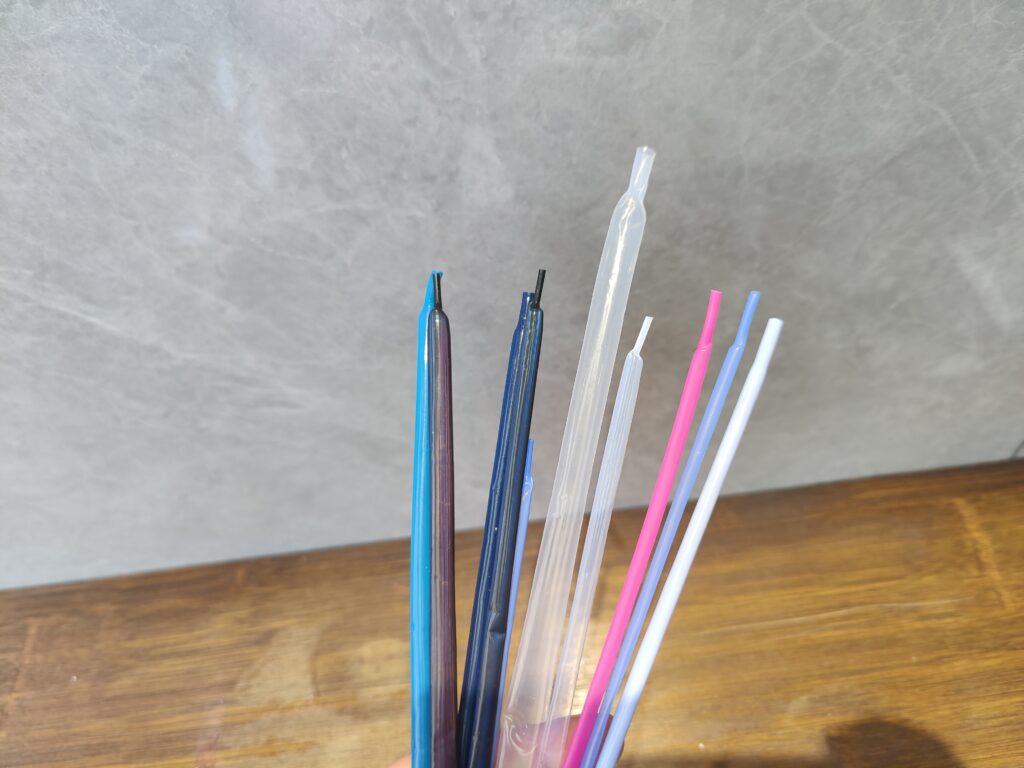
In a plasma surgical knife component project, the customer required electrical insulation and physical protection while maintaining a compact assembly and allowing the internal structure to remain visible.
The customer therefore selected a thin-wall FEP heat shrink tubing solution.
1. Thin-wall insulation helps maintain a compact component profile
In precision medical instruments, small changes in dimensions can affect assembly clearances and component compatibility.
For this project, the customer selected thin-wall FEP tubing to provide the required insulation without unnecessarily increasing the overall diameter.
A thinner protective layer helped maintain the compact dimensions required by the component design.
2. High transparency allows visual inspection of internal components
Transparency was another important reason for choosing FEP.
Unlike conventional PTFE tubing, which is generally translucent or milky white, FEP provides excellent optical clarity.
After shrinking, the transparent tubing allows operators to observe internal component positioning and certain assembly details.
This is particularly valuable when precise alignment and visual inspection are important.
3. Excellent electrical insulation without unnecessary protective thickness
The customer required electrical insulation and protection, but did not need an excessively thick protective layer.
The selected FEP tubing provided the required insulation performance while supporting a thinner and more transparent design.
Its relatively lower recovery temperature also offers a processing advantage for assemblies containing temperature-sensitive components.
Why was PTFE not selected?
PTFE can also provide excellent electrical insulation. However, its higher continuous temperature capability was not the main priority for this particular component.
The customer placed greater importance on thin-wall construction, transparency, and maintaining a compact assembly.
Conventional PTFE tubing would not provide the same optical clarity, while its additional high-temperature capability would offer limited value if the application requirements were already satisfied by FEP.
Therefore, FEP was selected because it provided the required insulation and protection while better meeting the customer’s thin-wall and visibility requirements.
This selection applies to the specific component design. It does not imply that FEP is suitable for every part of a plasma surgical knife, particularly areas exposed to extreme operating temperatures.
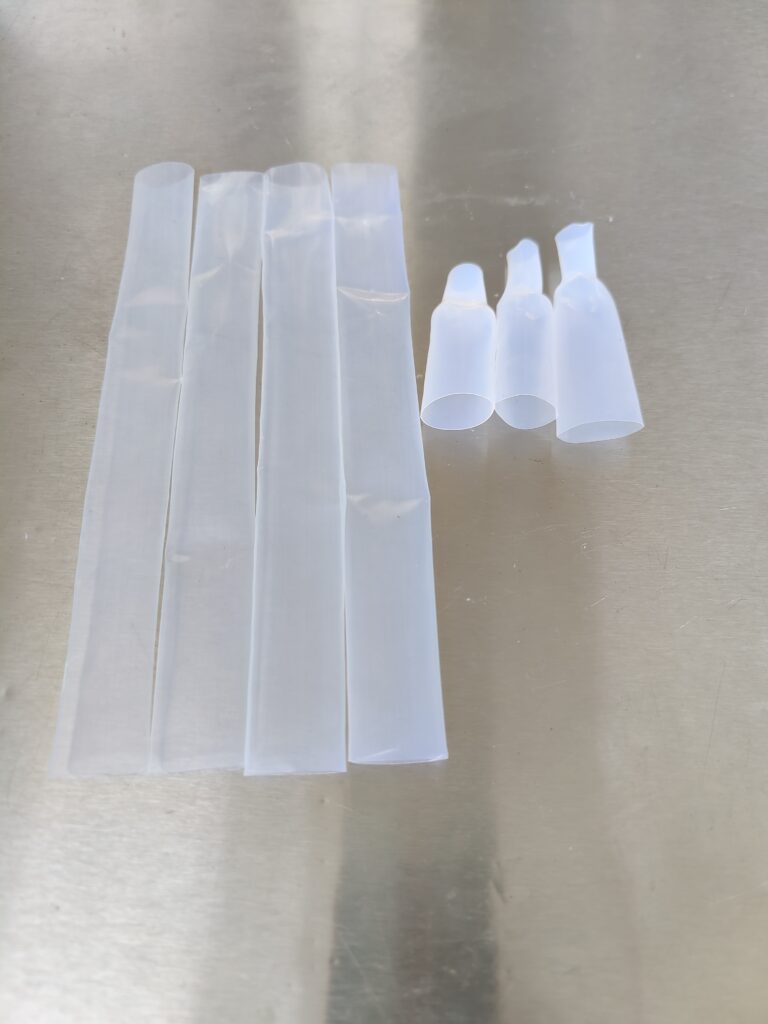
Case Study 2: Why Was PTFE Selected for Medical Nickel Metal Strip Protection Instead of FEP?
In another medical device project, the customer required insulation and protection for nickel metal strips.
Unlike the plasma surgical knife project, this application did not prioritize transparency or minimizing protective wall thickness.
Instead, the customer focused on stronger physical protection, greater thermal resistance, chemical stability, and long-term reliability.
The customer therefore selected a thicker-wall PTFE heat shrink tubing solution.
1. Thicker insulation provides additional physical protection
Nickel metal strips are electrically conductive, and their edges and surface geometry may create localized mechanical stress on an insulating layer.
For this project, the customer selected PTFE tubing with a greater wall thickness to provide additional protective coverage.
A properly designed thicker insulating layer can improve physical separation and reduce certain risks associated with localized mechanical damage.
This provides an additional protection margin for the metal component.
2. Higher temperature resistance provides greater thermal margin
PTFE typically supports continuous operating temperatures up to approximately 260°C, compared with around 200°C for FEP.
This higher temperature capability provides additional thermal margin for applications that may experience elevated operating temperatures.
For the nickel strip project, the customer preferred the higher-temperature material as part of a more protective insulation design.
3. Excellent chemical stability supports demanding environments
PTFE provides excellent resistance to many chemicals and maintains its material properties under a broad range of operating conditions.
Combined with the selected thicker-wall construction, it can offer a robust protective solution for metal components.
However, the complete assembly must still be designed to prevent unwanted exposure through openings or damaged areas.
4. Long-term protection was more important than transparency
Unlike the plasma surgical knife component, the nickel metal strip application did not require clear visibility of the underlying metal after shrinking.
As a result, the transparency advantage of FEP was less relevant.
Instead, the customer prioritized protective wall thickness and the higher thermal performance of PTFE.
The combination of these characteristics was better aligned with the project’s long-term protection objectives.
Why was FEP not selected?
FEP also provides excellent electrical insulation and chemical resistance, and it can be manufactured with thicker walls.
However, the customer wanted a higher-temperature fluoropolymer combined with a thicker protective structure.
For this project, PTFE provided the preferred balance of insulation, thermal capability, and protective design.
PTFE was selected not because FEP cannot protect metal components, but because the chosen PTFE construction better matched the customer’s requirements for reinforced protection and long-term reliability.
Actual service life still depends on operating conditions and should be verified through appropriate electrical, thermal-aging, and mechanical durability testing.
8. Precision Heat Shrinking: How Does FOBOS Control Processing Quality?
FEP and PTFE heat shrink tubing require different processing temperatures.
PTFE generally requires significantly higher temperatures for full recovery, while FEP can typically shrink at lower temperatures.
However, at FOBOS, these differences do not limit our ability to process either material.
We use independently developed temperature-controlled ovens designed to provide controllable and uniform heating for fluoropolymer heat shrink processing.
Our processing approach considers material type, tubing dimensions, wall thickness, shrink ratio, and component geometry.
Precise temperature control
Different materials and wall thicknesses require suitable heating conditions. Proper temperature control helps prevent insufficient recovery or localized overheating.
Uniform heating
Consistent heat distribution helps reduce uneven shrinkage, wrinkles, and dimensional variation.
Process consistency
By controlling temperature, heating time, and cooling conditions, we aim to improve repeatability across different products and production batches.
For thin-wall FEP tubing, processing focuses on dimensional recovery, uniform coverage, and maintaining the required transparent appearance.
For thicker-wall PTFE tubing, processing focuses on sufficient recovery at higher temperatures, wall thickness distribution, and complete coverage of the metal component.
Our processing capabilities allow us to select materials based on customer application requirements rather than being restricted by heating equipment limitations.
9. How to Choose Between FEP and PTFE Heat Shrink Tubing
| Application Requirement | Recommended Option | Main Reason |
|---|---|---|
| Transparent Component Protection | FEP | Excellent optical clarity |
| Thin-Wall Precision Insulation | Thin-wall FEP solution | Supports compact dimensions and visibility |
| Lower Heat Shrink Processing Temperature | FEP | Generally lower recovery temperature |
| Cost-Sensitive Applications | FEP | Often more economical |
| Continuous Operating Temperature Above 200°C | PTFE | Higher temperature capability |
| High-Temperature Electrical Insulation | PTFE | Better thermal stability |
| Reinforced Protective Coverage | Appropriate thicker-wall design, often PTFE when higher thermal performance is required | Additional protective thickness and thermal margin |
| Demanding Chemical Environments | Evaluate PTFE and FEP against actual chemicals and temperature | Both offer excellent chemical resistance |
| Transparent Chemical-Resistant Protection | FEP | Combines transparency and chemical stability |
10. Frequently Asked Questions
Is FEP heat shrink tubing cheaper than PTFE?
FEP heat shrink tubing is generally more economical for many standard specifications due to differences in material processing and manufacturing requirements.
However, actual pricing depends on raw material grades, dimensions, tolerances, shrink ratios, order quantities, and customization.
Can FEP heat shrink tubing replace PTFE?
In some applications, yes.
If FEP meets the operating temperature, electrical insulation, chemical resistance, and mechanical requirements, it may be a suitable alternative.
However, applications requiring higher continuous operating temperatures or specific PTFE characteristics may not be suitable for substitution.
Is PTFE always better for medical devices?
No.
PTFE offers higher temperature resistance, but FEP provides advantages in transparency, flexibility, and lower-temperature processing.
The appropriate material depends on the specific medical component and its validated design requirements.
Does thicker PTFE tubing provide better insulation?
Increasing the wall thickness of a properly designed insulating layer can provide additional insulation margin and physical protection.
However, the actual dielectric performance depends on material quality, component geometry, operating conditions, and the minimum recovered wall thickness.
Can FEP and PTFE heat shrink tubing be customized?
Yes. Both materials can be manufactured in different dimensions, wall thicknesses, lengths, and shrink ratios, subject to manufacturing capabilities.
For precision medical components and irregularly shaped metal parts, sample evaluation is recommended to confirm fit, shrink performance, and final protection.
11. Conclusion: Select the Right Material for the Application
FEP and PTFE heat shrink tubing both offer excellent fluoropolymer performance, but each has distinct advantages.
FEP is often preferred for applications requiring transparency, flexibility, lower recovery temperatures, and cost-effective processing.
PTFE is better suited to applications requiring higher continuous temperature resistance, low friction, and additional performance margins in demanding environments.
The two medical application projects at FOBOS illustrate these differences.
For the plasma surgical knife component, the customer selected thin-wall FEP tubing because it provided the required electrical insulation while maintaining a compact structure and allowing visual inspection of internal components.
For the nickel metal strip project, the customer selected thicker-wall PTFE tubing because the design prioritized reinforced protection, higher temperature resistance, and long-term reliability.
At FOBOS, we manufacture customized FEP and PTFE heat shrink tubing and support different processing requirements using our independently developed temperature-controlled ovens.
Our goal is to help customers select the most suitable fluoropolymer material, wall thickness, and heat shrink solution for their specific applications.
Contact
Phone/WhatsApp: +86 18914343919
Email: info@fobospolymer.com
contact: https://fobospolymer.com/contact/